AOU Convenes Africa-Focused Dialogue on Information Resilience in Connection with UNESCO Global Media and Information Literacy Week 2026
Africa Open University held an online public event linked to UNESCO Global Media and Information Literacy Week 2026 together with multiple partners. The dialogue explored information disorder, AI-fueled manipulation and the illusory truth effect in Africa’s digital ecosystem. It highlighted the differences among misinformation, disinformation and malinformation, and called for shared efforts from journalists, educators, platforms, institutions and citizens to build continental information resilience, with cross-border cooperation and proper governance frameworks.
The online public event examined information disorder, AI-enabled manipulation, media literacy and the shared responsibilities required to strengthen Africa’s information ecosystems.
ONLINE, 30 October 2026 — Africa Open University (AOU) convened an online public event titled “Building Information Resilience in Africa: Media Literacy, Misinformation and Governance in the Age of AI.”
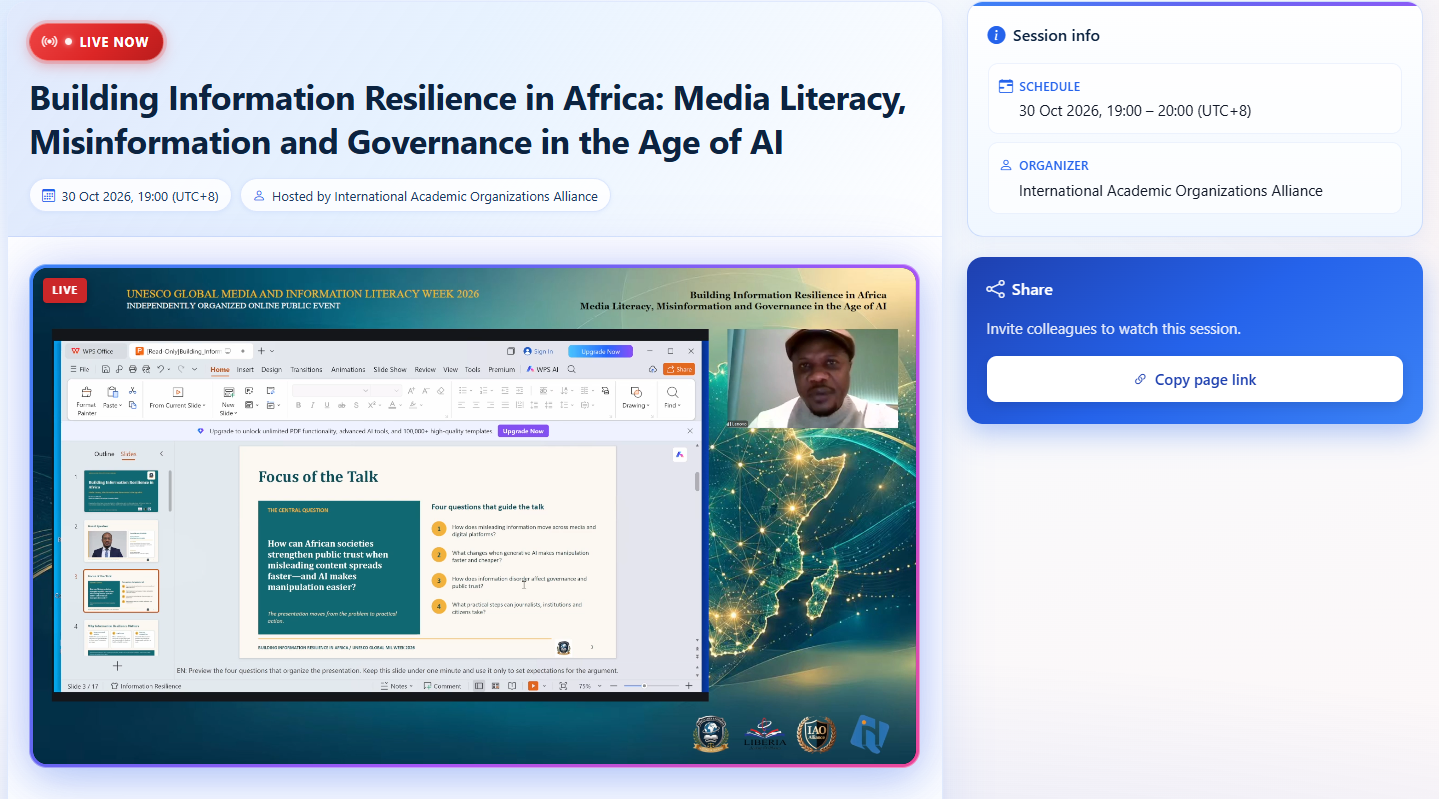
The event was independently organised in connection with UNESCO Global Media and Information Literacy Week 2026, in collaboration with the Liberia Academy of Sciences (LAS), the International Academic Organizations Alliance (IAOA) and Beijing Talent Technology Co., Ltd. Invited participants joined through Zoom, while a wider audience followed the event through the public livestream.
David Bashiel Kolleh, Secretary-General of AOU and Editor of Global Humanities and Social Sciences, delivered the featured presentation. From 2018 to 2024, he served as Assistant Minister for Technical Services at Liberia’s Ministry of Information, Cultural Affairs and Tourism.
The presentation distinguished three major forms of information disorder. Misinformation refers to false or inaccurate information shared without an intention to deceive. Disinformation is false or manipulated information deliberately created or distributed to mislead people or advance political, financial or other interests. Malinformation involves authentic information that is disclosed, reframed or presented out of context with the intention of causing harm. The discussion stressed that intent is an important distinction, while any legal assessment must depend on the applicable law and available evidence.
The meeting examined several factors driving information disorder across Africa. The widespread use of WhatsApp, Facebook, TikTok and other digital platforms enables information to travel rapidly across communities and borders. At the same time, gaps in timely and authoritative public communication can weaken trust and create information vacuums in which misleading claims spread easily.
Generative artificial intelligence has further reduced the time and cost required to produce convincing false text, images, audio and video. AI-generated content can imitate local languages, communication styles and cultural contexts, making manipulation more difficult for ordinary users to identify. The discussion also addressed the “liar’s dividend”: as synthetic media becomes more common, individuals may attempt to dismiss genuine recordings, photographs or documents as AI-generated fabrications.
Participants examined how misleading content can move through an information ecosystem. Content created by malicious or politically motivated actors may first be amplified by social media algorithms, influencers and organised interest groups before reaching traditional media, including radio programmes that have not adequately verified their sources. Repeated exposure can make a false claim feel familiar and therefore more credible, a phenomenon commonly known as the illusory truth effect.
The discussion emphasised that information resilience requires shared responsibility. Journalists should verify information before publication; educators should integrate media, information and AI literacy into learning at different levels; civil society organisations should support fact-checking and public awareness; and public institutions should provide accurate and timely information in languages understood by local communities. Technology platforms were also urged to improve transparency, content moderation and responses to demonstrably harmful false information.
Citizens were encouraged to pause before sharing, check the original source, date, location and context, and compare claims with independent and credible sources. Unnatural visual details, inconsistent shadows, irregular audio or unsynchronised lip movements may sometimes serve as warning signs, but the meeting cautioned that such flaws alone are no longer reliable proof that content was generated by AI.
The event concluded with a call for stronger national information resilience strategies, appropriate data protection and platform governance frameworks, improved public communication and greater cross-border cooperation. Historical experience—including the destructive role of hate media and incitement during the 1994 Genocide against the Tutsi in Rwanda—demonstrates that unchecked harmful communication can have serious consequences for public safety and social cohesion.
Through this dialogue, AOU and its collaborating organisations reaffirmed the importance of media and information literacy, responsible use of artificial intelligence and coordinated action in building more trustworthy and resilient information environments across Africa.